Why Aerospace Companies Are Choosing Bangalore in 2026
Bangalore has always been India's aerospace capital. HAL (Hindustan Aeronautics Limited), ISRO, NAL (National Aerospace Laboratories), and DRDO are all headquartered here. But what has changed dramatically in 2026 is the scale of private and foreign aerospace investment arriving in Karnataka.
At the Invest Karnataka 2026 Summit held in March, 48 companies signed MoUs worth ₹51,469 crore — a significant share in aerospace, automotive, and advanced manufacturing. Companies such as Axiscades, Mahindra Aerospace, NewSpace Research, and Unimech committed fresh capital to Karnataka, collectively expected to generate 70,000 jobs across the state.
This is not just domestic momentum. US-China trade tensions have accelerated global aerospace supply chain diversification. US, European, and Japanese tier-2 and tier-3 aerospace suppliers are actively evaluating India — and specifically Bangalore — as their manufacturing and MRO base. The city's combination of a mature aerospace ecosystem, KIADB-allocated industrial zones, and deep engineering talent makes it the natural choice.
If your company is evaluating aerospace or defence manufacturing space in Bangalore, this guide covers everything you need to know: zone selection, infrastructure requirements, approval timelines, rent benchmarks, and how Enosh Infra can compress your site-selection timeline from months to weeks.
The Aerospace Industrial Ecosystem Around Bangalore
Understanding where aerospace activity concentrates in Bangalore determines where you should look for space.
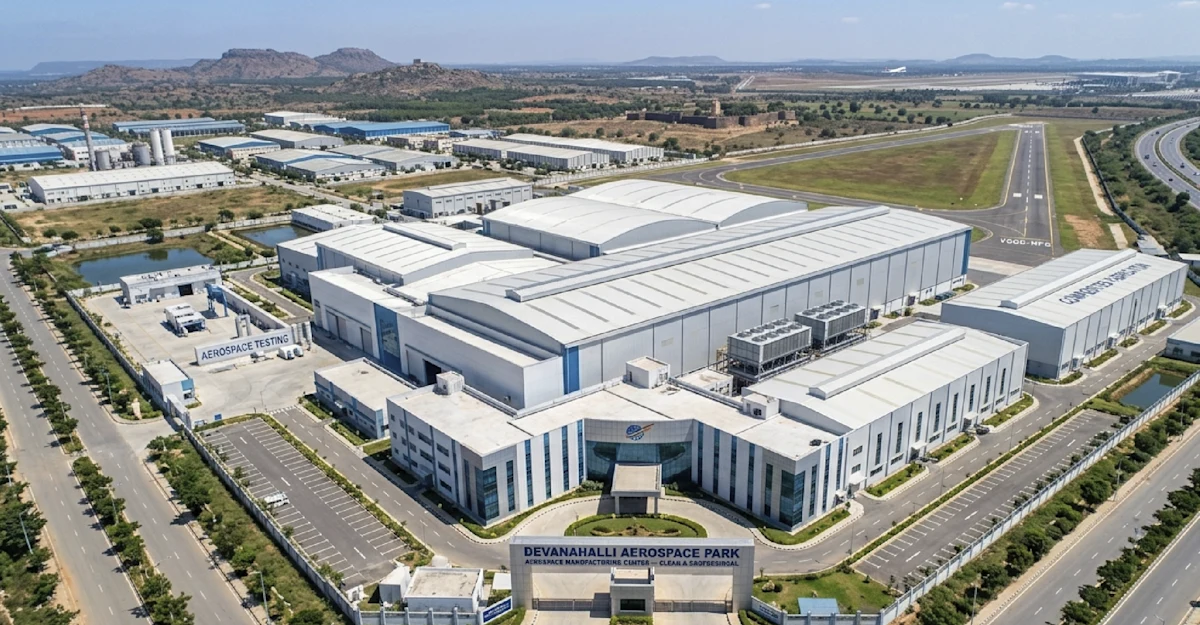
Devanahalli — the emerging aerospace corridor Devanahalli is home to Kempegowda International Airport and has become Bangalore's fastest-growing industrial zone. The KIADB industrial areas here are well-suited for aerospace: direct airport proximity (critical for MRO operations, component exports, and time-sensitive logistics), KIADB-allotted land parcels of 1–10 acres for custom factory development, and an upcoming Aerospace and Precision Engineering SEZ in the pipeline under Karnataka's industrial policy.Properties available: industrial sheds (30,000–1,50,000 sq ft), factory sheds on KIADB-allotted plots (1–5 acres), and controlled-environment warehouses for sensitive component storage.
Jigani and Bommasandra — precision engineering corridor Jigani and Bommasandra form Bangalore's precision engineering and electronics manufacturing belt. These zones host a dense cluster of tier-2 aerospace component suppliers, CNC machining units, and defence electronics firms. Properties here tend to be mid-size (15,000–60,000 sq ft) and are well-connected to the Hosur industrial belt extending into Tamil Nadu.
Peenya — established industrial hub Asia's largest industrial estate, Peenya hosts several defence and aerospace component manufacturers. ABB announced a $75 million Karnataka expansion in 2026, extending its Peenya campus by 6,100 sqm. While land availability in Peenya is constrained and rentals are higher, the ecosystem of vendors, raw material suppliers, and skilled fabricators is unmatched anywhere else in Bangalore.
Hoskote and Dobbaspet — large-format industrial Hoskote and Doddaballapura offer the largest available floor plates in Bangalore's industrial belt — sheds of 50,000–2,00,000+ sq ft with higher clear heights and unrestricted heavy vehicle access. For aerospace companies needing large component storage, bonded warehousing for imported tooling, or large assembly buildings, these corridors provide the best options at competitive rents.
Whitefield and Electronic City — aerospace R&D and GCC Companies needing aerospace R&D centres, simulation labs, or engineering design offices (rather than manufacturing) will find Whitefield and Electronic City ideal. Rolls-Royce's global GCC in Bangalore — expanded to become the company's largest tech hub worldwide — operates here, focused on aerospace engineering, digital twins, and enterprise services. For the office component of an India aerospace setup, Enosh Infra's tech park and managed office services cover this need alongside the industrial search.
What Aerospace Industrial Space Must Have — Technical Checklist
Standard warehouses are designed for FMCG or e-commerce. Aerospace manufacturing and MRO have specific requirements that disqualify most generic spaces. Evaluate every property against this checklist before proceeding to a site visit.
Structural and spatial
Clear internal height: minimum 10–12 m for assembly work; 15–20 m for large structure or hangar-type operations
Floor load capacity: minimum 5 T/sqm for heavy tooling and jigs; 10+ T/sqm for engine test cells
Column-free spans: minimum 24 m; 36–48 m preferred for aircraft bay configurations
Floor flatness: FM2 standard (5 mm tolerance over 3 m) for precision assembly
Power and utilities
Power supply: 200–1,000 KVA depending on scale; three-phase mandatory
Dedicated transformer with 100% DG backup for controlled processes
Compressed air infrastructure or compressor room space
High-speed fibre for connected manufacturing and ERP systems
Environmental control
Humidity and temperature control: required for composite material layup, avionics testing, and precision component storage
ESD (electrostatic discharge) flooring for avionics and defence electronics areas
Vibration isolation foundations for metrology and inspection equipment
Loading and logistics
Entry doors: minimum 6 m wide × 6 m high for large component transport; 12 m × 10 m for larger assemblies
Road access: minimum 40-foot road for heavy transport vehicles
Hardstanding area for aircraft ground handling or large component staging
Zone and regulatory
KIADB-allotted or KIADB-approved zone: mandatory for manufacturing licences
Orange zone classification minimum for most aerospace manufacturing activities
PCB (Pollution Control Board) Consent to Establish — timeline and category depends on activity
Safety
Sprinkler systems and firefighting infrastructure: mandatory for composite manufacturing (flammable prepregs and resins)
Designated hazmat zones for chemicals, lubricants, and fuel handling
Security perimeter, especially for defence contracts under DPSU or private defence licences
Enosh Infra's pre-inspection process checks all of these points before we bring a client to a site visit. Our shortlists contain only properties that have already been verified against your technical brief. See our warehouse listings page for the broader industrial inventory, and contact us with your aerospace specification for a focused shortlist.
KIADB Industrial Zones: What Aerospace Companies Need to Know
The Karnataka Industrial Areas Development Board (KIADB) is the primary land authority for industrial property allocation in Karnataka. For aerospace and defence companies — particularly foreign entities setting up in India — KIADB-allotted land or sheds offer significant advantages over private industrial estates:
Secure land title: KIADB plots carry clear title, reducing legal risk for long-term capital investment
Pre-developed utilities: Power, water, and road infrastructure are installed by KIADB before allotment
Single-window approvals: Karnataka's portal covers 150+ business services across 30+ departments
Simpler factory licences: KIADB zone classification streamlines Factory Act registration and PCB clearance
Key KIADB clusters for aerospace: Devanahalli KIADB (Phases 1 and 2) offers plots from 2,400 sqm to 2 hectares, primarily in Orange zone. For activities involving combustible materials, propulsion components, or chemical processing (Red zone), Dobaspet and Hoskote KIADB clusters are better suited, with larger plot sizes and appropriate separation distances. For companies needing to move fast, an existing KIADB-zone shed with a clean title and current factory licence can be occupied in 45–90 days. A fresh KIADB plot allotment takes 12–24 months. Enosh Infra advises on which path fits your timeline and manages the KIADB process alongside your property search. Explore KIADB industrial zones for a full breakdown of each zone across Karnataka.
Rent Benchmarks: Aerospace Industrial Space in Bangalore (2026)
These are indicative 2026 benchmarks based on Enosh Infra's current market activity. Actual terms depend on spec, lease duration, and landlord. Devanahalli — new construction, Grade A ₹18–26/sq ft/month | Deposit: 6–12 months | Lease: 5–9 years KIADB plot purchase: ₹3,500–6,500/sqm Jigani / Bommasandra — existing shed, mid-spec ₹20–28/sq ft/month | Typical size: 15,000–60,000 sq ft Floor load: 3–5 T/sqm standard; 8–10 T/sqm requires pre-verification Peenya — limited availability, high-spec ₹28–38/sq ft/month | Clear height typically 8–12 m (verify before committing) Availability is constrained; primarily sub-lease or resale situations Hoskote / Dobbaspet — large-format, highway-connected ₹14–20/sq ft/month | Sizes: 50,000–2,00,000+ sq ft Best for: large assembly buildings, bonded warehouses for imported components; clear heights 10–14 m in newer builds
Approval Timelines: What to Realistically Expect
Pre-lease technical diligence (Enosh Infra process): 2–4 weeks Property shortlisting, structural assessment, zone verification, power load check, KIADB title verification. Our team handles this before you make a single site visit. Lease agreement and legal review: 2–4 weeks Enosh Infra conducts in-house legal review of lease terms, subletting rights, force majeure clauses, and exit provisions. Factory Act registration: 4–8 weeks After possession, Factory Inspector inspection and registration under the Factories Act 1948. KIADB plot allotment (new land): 12–24 months Direct allotment requires application, technical scrutiny, site visit, and Board approval. Existing sheds within a KIADB zone bypass this entirely. PCB Consent to Establish: 6–12 weeks For Orange or Red zone activities. Green zone activities (warehousing, assembly, testing only) are simpler. Import bonding for MRO: 8–12 weeks Customs bonded warehouse licence under the Customs Act, if required for imported aircraft components or tools.The fastest path: an existing shed in a KIADB zone with a clean title, current factory licence, and existing power infrastructure. Enosh Infra maintains a pipeline of such properties that are not publicly listed. Contact us with your brief to access it.
Foreign Aerospace Companies: India Entry Considerations
For US, European, Japanese, or Korean aerospace companies evaluating a Bangalore manufacturing base, property selection is one part of a broader India entry process. 100% FDI permitted: For manufacturing and MRO operations, 100% FDI is under the automatic route. Defence manufacturing allows 74% FDI automatically and up to 100% with government approval. FEMA compliance: Foreign entities must lease through an Indian subsidiary. Enosh Infra works alongside company formation advisors to help foreign clients establish the right entity structure before the lease is signed. DGFT licences for aerospace imports: Importing aerospace-grade materials and tooling requires an IEC (Import Export Code) and, in some cases, a SCOMET licence. These run parallel to property occupancy but must be planned early. Karnataka incentives to claim before occupancy: Companies may be eligible for rental reimbursement, 5-year electricity duty exemption, and EPF contribution support under the 2024 Karnataka Industrial Policy. These must be registered before occupation — not retroactively.For companies needing a complete India setup — registered entity, office space, and industrial facility together — Enosh Infra's GCC and Business launch service covers the full scope.
Conclusion: Bangalore's Aerospace Moment Is Now
The Invest Karnataka 2026 summit confirmed it: aerospace and defence is a top-priority sector for Karnataka for the next five years. With Axiscades, Mahindra Aerospace, and NewSpace Research all making fresh capital commitments in March 2026, and with global supply chain realignment driving US, European, and Japanese aerospace suppliers toward India, the demand for quality industrial space near Bangalore's aerospace corridor is real and accelerating.
What aerospace companies cannot afford is the wrong space — insufficient clear height, inadequate power infrastructure, or a title that complicates the factory licence process. This is exactly where Enosh Infra's pre-inspection process, KIADB zone expertise, and in-house legal review protect clients from costly mistakes and delays.
Whether you are evaluating your first India manufacturing facility, a supply chain diversification base, or an MRO operation, contact Enosh Infra for a focused shortlist matched to your technical specifications and timeline.
Phone / WhatsApp: +91-8073582033 Email: info@enoshinfra.com