Managed Office vs Conventional Lease in Bangalore: The Complete 2026 Guide
Bangalore's commercial real estate market offers two fundamentally different ways to occupy office space — and picking the wrong one can cost your business months of productivity or significant avoidable expenditure.
In 2026, both options are more refined than ever. Managed office operators have expanded significantly across Whitefield, Outer Ring Road, and Hebbal. Meanwhile, Grade A conventional lease stock in Prestige, Embassy, and RMZ parks continues to attract companies that want permanence and identity. The question isn't which is "better" — it's which fits your business stage, team size, and financial model.
This guide gives you a straight comparison so you can make a confident decision.
What Is a Managed Office?
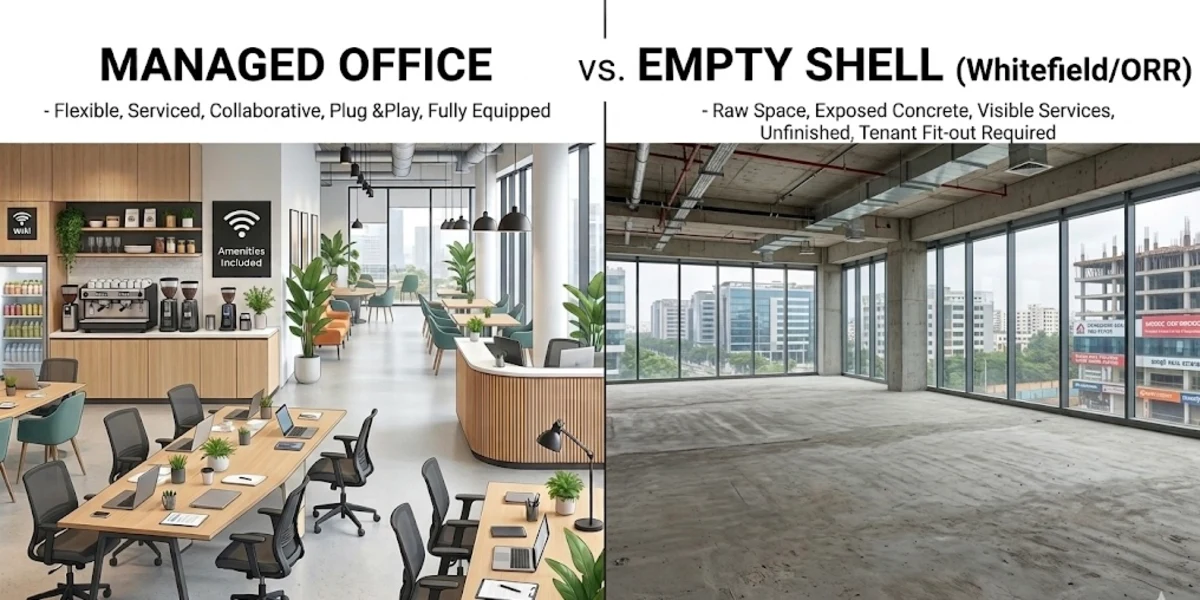
A managed office (also called a serviced office or plug-and-play office) is a fully furnished, fully operational workspace that you pay for on a per-seat or per-sq-ft basis, inclusive of most overheads. The operator — companies like Incubex, IndiQube, WeWork, 315Work Avenue, CoWrks, iKeva, or GoodWorks in Bangalore — handles the fit-out, housekeeping, internet, power backup, reception, and common amenities.
You sign a licence agreement (not a lease), typically for 12–36 months, and move in within days.
What's usually included:
Fully furnished workstations, cabins, and meeting rooms
High-speed internet and IT infrastructure
24/7 power backup and air conditioning
Reception and security staff
Common area maintenance (CAM) charges — bundled in
Pantry, cafeteria access, or both
Access to shared meeting rooms (limited hours per month)
What's typically extra:
Dedicated meeting room hours beyond the monthly allowance
Printing infrastructure
Branding and signage (varies by operator)
Parking (often charged separately at ₹3,000–₹6,000/bay/month)
What Is a Conventional Lease?
A conventional lease (also called a direct lease or traditional lease) is a bare-shell or warm-shell office space rented directly from a developer or landlord under a formal Leave & Licence or Lease & Licence agreement. You pay rent per square foot per month and take full responsibility for fit-out, furnishing, operations, and maintenance.
Lease tenures in Bangalore typically run 3–9 years with a lock-in of 1–3 years, and rent escalation clauses of 5–15% every 3 years.
What you control:
Custom interior design and branding
Technology and network architecture
Vendor selection for housekeeping, cafeteria, security
Floor layout and expansion within the leased floor
What you pay separately:
Fit-out and interior works (₹800–₹2,500/sq ft depending on grade)
Common Area Maintenance (CAM) charges: ₹15–₹40/sq ft/month
Electricity at actuals
Security deposit: 6–10 months' rent
Brokerage: typically one month's rent (for tenant, through a consultant)
Cost Comparison: Managed Office vs Conventional Lease (Bangalore, 2026)
The most common mistake companies make is comparing only the headline rent numbers. Here's a full-cost view for a 50-seat team in a mid-tier Bangalore location (ORR/Whitefield corridor):
Managed Office — 50 seats
Cost Head | Amount |
Seat charge (₹12,000/seat × 50) | ₹6,00,000/month |
Parking (10 bays × ₹4,500) | ₹45,000/month |
Security deposit (3 months) | ₹18,00,000 (one-time) |
Fit-out / furniture | ₹0 |
Total Month 1 outflow | ~₹20,45,000 |
Ongoing monthly | ~₹6,45,000 |
Conventional Lease — ~6,000 sq ft (Grade A, ORR)
Cost Head | Amount |
Rent (₹85/sq ft × 6,000) | ₹5,10,000/month |
CAM (₹25/sq ft × 6,000) | ₹1,50,000/month |
Electricity (estimate) | ₹60,000/month |
Housekeeping + security | ₹80,000/month |
Security deposit (6 months) | ₹30,60,000 (one-time) |
Fit-out (₹1,500/sq ft) | ₹90,00,000 (one-time) |
Total Month 1 outflow | ~₹1,28,60,000 |
Ongoing monthly | ~₹8,00,000 |
The managed office costs more per month once fully operational, but the conventional lease requires nearly ₹1.2 crore upfront before a single employee sits down. For most companies, that is the deciding factor.
Setup Timeline: Where the Real Difference Lies
Managed Office | Conventional Lease | |
Time to identify space | 1–2 weeks | 2–4 weeks |
Agreement execution | 3–7 days | 3–6 weeks (legal review, stamp duty) |
Fit-out and interior works | 0 (already done) | 8–20 weeks |
IT and network setup | 1–3 days | 2–4 weeks |
Total to move-in | 2–4 weeks | 3–6 months |
For GCCs launching their first India office, or any company that needs to be operational before a particular project deadline, the managed office timeline is simply non-negotiable.
Flexibility and Exit Terms
This is where managed offices win decisively for early-stage or uncertain-growth businesses.
Managed office:
Licence agreements — easier to exit than leases
Expansion: add seats within the same building, often within days
Contraction: reduce seats at renewal with notice
Exit penalty: typically 1–3 months' notice or lock-in period
No CAM disputes, no dilapidation liability on fit-out
Conventional lease:
Lease deed — legally stronger, harder to exit mid-term
Expansion requires negotiating additional floor or new property
No mid-term reduction without landlord consent
Exit requires dilapidation (restoring space to original condition): ₹200–₹600/sq ft
Lock-in clauses of 12–36 months are standard
If your headcount is likely to change by more than 20–30% in the next 18 months — in either direction — a managed office is the more sensible choice.
Brand Identity and Culture
This is the area where conventional leases have a genuine advantage.
A managed office is, by design, shared infrastructure. Your reception may carry your name, but the building entrance, elevator lobby, common areas, and cafeteria are shared with other tenants. For companies where physical brand presence matters — enterprise sales teams, financial services firms, firms hosting frequent client visits — this can be a real constraint.
With a conventional lease, you design everything: the entrance experience, the layout, the café brand, the wall art. Many GCCs and Indian enterprises value this as a signal of permanence and commitment to their India operations.
Verdict: If you're a 200+ person team with a stable headcount and strong brand culture, the conventional lease's identity advantage justifies the cost.
HR and Talent Attraction: Does Office Type Matter?
In Bangalore's talent market, it does — but perhaps not in the way you'd expect.
Location and commute matter far more than whether the office is managed or conventional. A managed office in Whitefield will attract more candidates than a conventional lease office in Electronic City, regardless of how well the latter is designed.
What employees care about in 2026, in order: commute time, building quality, amenities (food, gym, parking), work environment, and flexibility. A well-chosen Grade A managed office building checks all of these. A conventional lease in a Grade B building does not, regardless of the fit-out budget.
For GCCs specifically: Starting in a managed office in a talent-dense location (ORR, Whitefield, Hebbal) while you establish your employer brand is almost always the right first move. Evaluate a long-term conventional lease only once you have 75–100+ headcount, confirmed growth trajectory, and 12–18 months of India operations under your belt.
When to Choose a Managed Office
Team size: 5–150 seats
Timeline: need to be operational within 4–8 weeks
Capex constraint: limited upfront budget
Growth uncertainty: headcount may double or halve
GCC or new entity: testing India market before committing
Remote/hybrid: lower daily utilisation doesn't justify full floor
When to Choose a Conventional Lease
Team size: 150+ seats with stable headcount
Timeline: 6+ months available for setup
Budget: capex available for fit-out investment
Brand: client-facing office requiring full identity
Long-term commitment: 5+ year India presence confirmed
Custom infrastructure: server rooms, labs, trading floors, secure zones
The Hybrid Approach: What Many Bangalore Companies Are Doing in 2026
An increasingly common pattern among mid-sized companies and GCCs is to run both simultaneously:
Core team
in a conventional lease headquarters for permanence, culture, and brand
Overflow / project teams / new locations
in managed offices for flexibility
This gives you the identity of ownership with the agility of flex. Enosh Infra regularly structures this kind of dual arrangement for clients expanding across Bangalore or adding a second city.
FAQ
Can I negotiate rent in a managed office? Yes — especially for 30+ seats or 24+ month commitments. Expect 10–20% off the rack rate. Operators rarely publish their best prices.
Is stamp duty applicable on managed office agreements? Managed offices use Leave & Licence agreements, which attract lower stamp duty than lease deeds in Karnataka. Your consultant will guide you on applicable charges.
What is a "warm shell" office? A warm shell is a partially fitted space — flooring, basic electrical, air conditioning, and sometimes false ceiling are done by the developer, but furniture, workstations, and IT are your responsibility. It sits between a bare shell (fully raw) and a managed office (fully operational).
Can a foreign company directly sign a managed office agreement? Yes, once the Indian entity (subsidiary, branch office, or LLP) is incorporated. Some operators allow agreements with foreign entities for very short-term setups pending incorporation, but this is operator-specific.
What happens to my data and servers in a managed office? You are responsible for your own IT security. Most managed offices provide only internet connectivity — your servers, VPN, and data remain entirely under your control. For high-security requirements (BFSI, defence), discuss infrastructure isolation with the operator before signing.
Ready to Evaluate Your Options?
Enosh Infra helps companies across Bangalore find the right office model — whether that's a managed seat in Whitefield, a full floor on ORR, or a conventional lease in a Grade A tech park. We work with both operators and direct landlords, so our advice is not tied to any single option.
Talk to an office space consultant →
Related reading: