Why Solar Companies Are Choosing Bangalore for Large Warehouses in 2026 — A Complete Guide
India's solar manufacturing industry is expanding at a pace that few sectors can match. As of mid-2025, India's solar module manufacturing capacity crossed 100 GW, with Karnataka emerging as one of the country's most critical production hubs. Bangalore-based manufacturers like Emmvee — which now operates four facilities across Dabaspet, Sulibele, and the ITIR Phase II zone with 7.8 GW of module capacity and 2.94 GW of cell capacity — are a clear signal of what's happening on the ground.
And where large-scale manufacturing goes, large-scale warehousing follows.
Whether you're a solar module manufacturer scaling production, an EPC contractor managing inventory across multiple project sites, a panel importer and distributor, or a solar component supplier (inverters, racking, cables, junction boxes), your warehouse requirements are specific, demanding, and non-negotiable. This guide breaks down exactly what you need — and where to find it in Bangalore. Browse our current large-format warehouse listings or read on for the full picture.
Why Bangalore? The Solar Ecosystem Advantage
Karnataka is not just a bystander in India's solar story. The state's industrial policy and KIADB infrastructure have made it one of the most attractive destinations for solar manufacturing investment.
Key drivers making Bangalore the right base for solar warehousing in 2026:
1. Active Manufacturing Cluster Emmvee's entire manufacturing base — four facilities — sits within 100 km of Bangalore. New integrated facilities are under construction at ITIR Phase II near Devanahalli. Tata Power Solar maintains a significant module production facility in the city. This density creates a support ecosystem: suppliers, logistics providers, and technical talent are all local.
2. PLI Scheme Momentum India's Production Linked Incentive (PLI) scheme allocated ₹24,000 crore to boost domestic solar module production. Karnataka manufacturers are direct beneficiaries, and the resulting production ramp-up means warehouse demand for raw material staging, finished goods storage, and project dispatch is rising sharply.
3. ALMM List-II Compliance Driving Domestic Storage Demand From June 2026 onwards, all government solar projects must source cells from ALMM List-II approved manufacturers. This regulatory shift is forcing solar companies to hold larger domestic inventory buffers — meaning bigger warehouses, closer to manufacturing.
4. Multimodal Logistics Access Bangalore offers NH-48 (to Mumbai and Chennai), NH-75 (to Kolkata via Hoskote), NH-44 (southward to Tamil Nadu), and proximity to Kempegowda International Airport — critical for imported components like inverters, racking systems, and specialty glass.
What Solar Companies Actually Need in a Warehouse
Solar industry warehousing is not generic. If you've approached a standard industrial broker and been shown a row of identical sheds, you've already experienced the problem. Here is what the industry actually requires.
Solar Panel Storage: The Physics Problem
Solar panels are more vulnerable in storage than most companies anticipate. Here's what causes inventory losses that insurers and manufacturers rarely advertise:
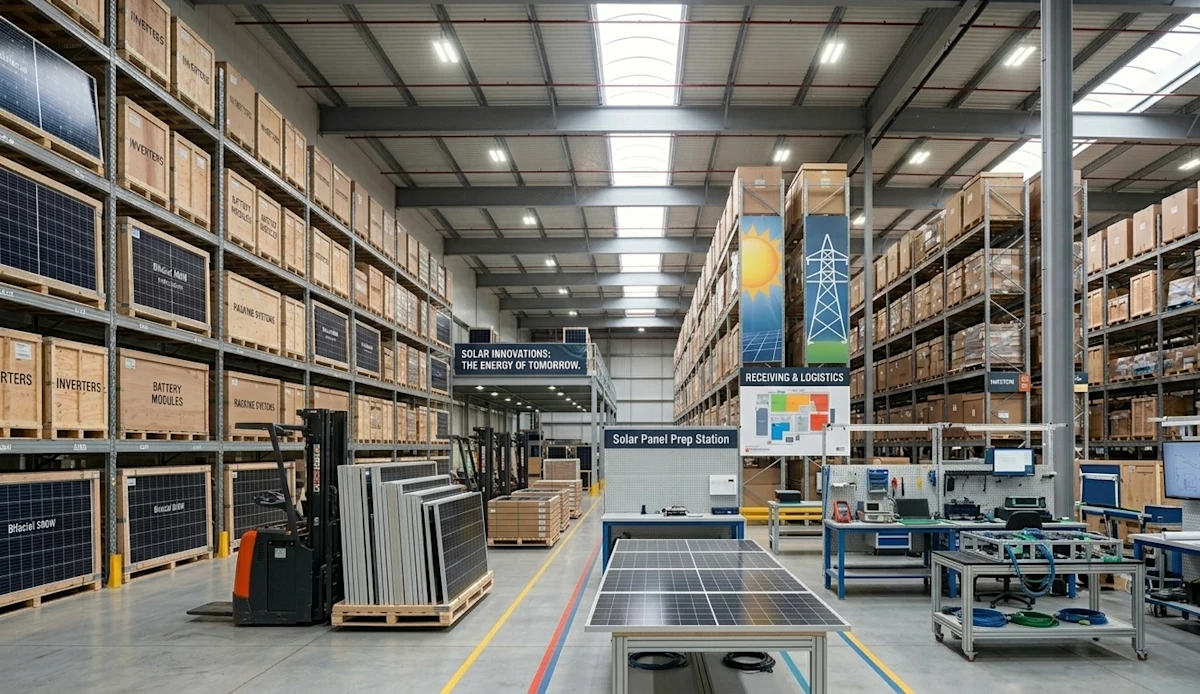
Micro-cracking from improper stacking. Panels stored horizontally in stacks of more than 4–5 units develop micro-cracks in the silicon cells from sustained pressure. Once cracked, output degrades 3–8% — often undetectable until installation. Solar warehouses must store panels vertically in purpose-built A-frame or pallet racking, which requires 30+ foot clear height and wider bay spacing than standard sheds.
EVA delamination from humidity. The encapsulant layer (ethylene vinyl acetate) between the glass and cells degrades in sustained humidity above 85% RH. Karnataka's monsoon season (June–September) pushes ambient humidity well past this threshold in non-climate-controlled sheds. Grade A solar warehouses require dehumidification systems maintaining 50–70% RH — factor this into your fit-out budget (approximately ₹8–15 lakh for 100,000 sq ft).
PID risk from dust contamination. Potential Induced Degradation accelerates when dust infiltrates packaging before installation. Warehouses near unsealed roads or in zones with heavy truck traffic require positive pressure ventilation systems or sealed loading dock airlocks.
These are not hypothetical risks. They are common causes of warranty disputes between EPC contractors and module manufacturers. The right warehouse eliminates them at source.
Structural Requirements
Clear Height (Eave Height) Solar panels stored vertically in A-frame racking, plus inverters and transformer assemblies requiring gantry crane clearance, mean most solar warehouses need a minimum clear height of 30–40 feet. Large manufacturers typically require 50–60 feet or more. Standard industrial sheds in Bangalore offer 20–25 feet — a common mismatch that costs companies weeks in shortlisting. Always measure at the lowest internal point, not the ridge.
Floor Load Capacity Solar glass, panel stacks, and battery storage systems are dense. Industrial warehouses for solar use typically require floor load ratings of 3–5 tonnes per square metre. Standard warehouses are rated at 1–2 T/m². Request the structural engineer's certificate — not the builder's spec sheet.
Column-Free or Wide-Bay Spans Solar panel rows and automated racking systems require clear, unobstructed floor space. Wide-bay construction (40–60 metre spans without intermediate columns) is essential for efficient storage layouts. Confirm bay width before shortlisting.
Power Infrastructure
This is where most solar warehouses in Bangalore face their first operational bottleneck.
Sanctioned Power Load A typical 100,000 sq ft solar warehouse requires 1,500–3,000 KVA of sanctioned load minimum for climate control, automated racking systems, EV charging for internal logistics, and security infrastructure. Manufacturing facilities require significantly more. Get the actual BESCOM sanction letter — not a verbal assurance from the landlord.
Power Redundancy Given the value of inventory — panel stacks worth significant sums — uninterrupted power is non-negotiable. Look for warehouses with DG backup, or factor in DG installation space in your fit-out budget.
Transformer Yard Space Larger facilities need dedicated transformer yard space outside the building footprint. Confirm this before signing any Letter of Intent.
Logistics Infrastructure
Truck Docking Solar panels arrive in 40-foot containers. Dispatch is typically via multi-axle trailers. Warehouses for solar use require dock-level loading bays (not ramp access) with a minimum of 6–8 dedicated truck docks for facilities above 100,000 sq ft. Clearance height at the dock must accommodate containerised trailers.
Turning Radius and Apron A 40-foot container requires a minimum 30-metre apron for a straight back-in. Many KIADB zone properties have tight aprons — visit the site and measure before committing.
Rail Connectivity For companies managing bulk imports of raw materials (solar glass, aluminium frames, EVA film), rail siding access is a significant logistics cost advantage. Hoskote and certain Nelamangala properties offer rail proximity.
Compliance and Zone Classification
Solar manufacturing sits at the intersection of two KIADB zone types:
Green Zone: Solar assembly, testing, storage, and distribution. Fast approvals (1–3 months), lower compliance cost (₹10,000–50,000).
Orange Zone: Some chemical processes (cell manufacturing involving chemical etching and doping). Moderate approvals (3–6 months), compliance cost ₹25,000–1,00,000.
Solar EPC contractors and distributors will typically qualify for Green zone classification. Manufacturers with cell production lines should confirm Orange or Red zone requirements with KSPCB before committing to a property.
Fire NOC Given the fire risk profile of lithium-based battery storage and solar materials, Karnataka State Fire and Emergency Services requires specific fire suppression systems. Ensure your shortlisted warehouse either has an active fire NOC or structural provisions for foam-based suppression. Request the certificate — not a pending application.
What to Tell Your Landlord: Pre-LOI Checklist
This is the list most tenants don't have until after they've wasted two months on a property that doesn't qualify. Before signing any Letter of Intent, get written confirmation on:
Sanctioned load (KVA) from BESCOM — request the actual sanction letter
Structural engineer certificate for floor load capacity (minimum 3 T/m² for panel storage)
Confirmed eave height at the lowest internal point (not the ridge height)
Truck apron depth (minimum 30 m for 40-ft container straight back-in)
Fire NOC status — active certificate, not a pending application
KIADB zone classification letter (request the allotment order)
Permission to install rooftop solar, explicitly stated in the lease deed
Right of first refusal on adjacent space for future expansion
Best Locations in Bangalore for Solar Warehouses
Based on current market activity, KIADB zone availability, and infrastructure assessment, here are the priority zones for solar companies in 2026.
1. Dabaspet — The Solar Manufacturing Corridor
Dabaspet is not just theoretically well-positioned — it is where India's solar manufacturing cluster is actively taking shape. Emmvee's three Karnataka manufacturing units sit in Dabaspet, and its fourth facility is in nearby Sulibele. The supply chain has followed: component suppliers, logistics companies, and service providers have taken space in the same corridor. For a new entrant to India's solar market looking to warehouse near an established manufacturing ecosystem — for supply chain proximity, talent access, or simply knowing your neighbours understand your business — Dabaspet offers something no other Bangalore zone currently does.
Zone: KIADB Green/Orange
Available sizes: 50,000 to 300,000+ sq ft
Rental range: ₹16–22 per sq ft per month
Key advantages: Most competitive rental in Bangalore's industrial belt, fast KIADB approvals, NH-48 access, 22% annual growth in industrial land values
Connectivity: NH-48 / Tumkur Road, approximately 55 km from Kempegowda International Airport
Ideal for: Module manufacturers, cell component suppliers, large-format storage operations
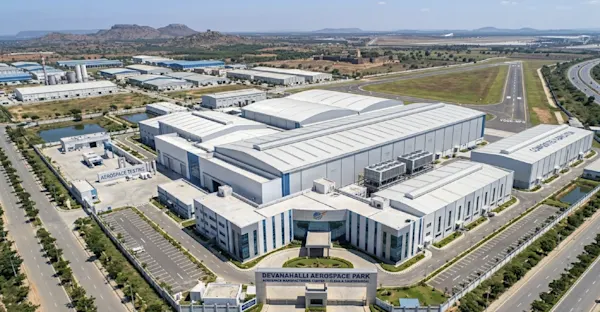
2. Devanahalli / ITIR Phase II — The Airport Proximity Advantage
Emmvee's newest 6 GW integrated facility is being constructed at ITIR Phase II, Devanahalli. The KIADB Industrial Township around the airport is one of Karnataka's fastest-growing industrial zones.
Zone: KIADB Green
Available sizes: 50,000 to 200,000+ sq ft
Rental range: ₹20–28 per sq ft per month
Key advantages: 8 km from Kempegowda International Airport (critical for imported components), Aerospace SEZ proximity, emerging Grade A shed stock, BESCOM high-tension infrastructure
Connectivity: NH-44 (Bellary Road), direct airport access road, proposed Satellite Town Ring Road (STRR)
Ideal for: Companies importing inverters, specialty glass, racking systems; export-oriented units; companies requiring air freight access
3. Nelamangala — The Logistics Hub
Nelamangala sits at the intersection of NH-48 (Bangalore–Mumbai) and the Bangalore–Pune logistics corridor, making it one of India's most strategically positioned warehousing locations.
Zone: KIADB Green
Available sizes: 50,000 to 200,000 sq ft
Rental range: ₹18–25 per sq ft per month
Key advantages: 25 km from Bangalore airport, direct highway access to Mumbai and Pune, well-established 3PL ecosystem, stable BESCOM power supply
Connectivity: NH-48, 22 km from Hebbal (north Bangalore)
Ideal for: EPC contractors managing multi-state project dispatches, distributors supplying north Karnataka and Maharashtra
4. Hoskote — The East Corridor
Hoskote is Bangalore's fastest-growing large-format industrial zone, with the highest concentration of warehouses above 100,000 sq ft in the region.
Zone: KIADB Green
Available sizes: 50,000 to 400,000+ sq ft — the widest range available in Bangalore
Rental range: ₹18–24 per sq ft per month
Key advantages: Rail connectivity, NH-75 access (to Kolkata and Chennai via Krishnapatnam Port), built-to-suit options available for 200,000+ sq ft requirements
Connectivity: NH-75 (Old Madras Road), 35 km from airport, direct highway to Kolar and Andhra Pradesh
Ideal for: Large-scale module manufacturers needing mega-space, companies with rail-based raw material imports, built-to-suit project requirements
5. Bommasandra / Jigani — South Bangalore's Industrial Anchor
The Bommasandra–Jigani–Attibele corridor is well-established for electronics and light manufacturing, with good quality shed stock.
Zone: KIADB Green/Orange
Available sizes: 30,000 to 150,000 sq ft
Rental range: ₹22–28 per sq ft per month
Key advantages: Electronic City proximity, NH-44 access to Tamil Nadu, established contractor and workforce ecosystem
Ideal for: Solar electronics companies, inverter assembly, battery management system manufacturers
Warehouse Size Guide for Solar Operations
Operation Type | Minimum Size | Recommended Size | Key Specification |
Regional distributor (1–2 states) | 20,000 sq ft | 40,000–60,000 sq ft | Dock-level loading, 30 ft height |
EPC contractor (project staging) | 50,000 sq ft | 80,000–1,20,000 sq ft | Laydown yard, heavy floor load |
Module assembly / testing | 80,000 sq ft | 1,50,000–2,50,000 sq ft | High power load, climate control |
Cell + module manufacturing | 1,50,000 sq ft | 3,00,000–4,00,000+ sq ft | Orange/Red KIADB, high power, EIA |
National distribution hub | 1,00,000 sq ft | 2,00,000–3,00,000 sq ft | Multi-modal logistics, 3PL-ready |
How Enosh Infra Helps Solar Companies
We maintain pre-inspected, pre-verified shortlists of large-format warehouses across every major KIADB zone in Bangalore, with documented specifications for clear height, floor load, sanctioned power, dock count, and zone classification. When a solar company comes to us with a requirement, we match against this database — not a classified ad board.
Our process for large warehouse requirements:
48-hour shortlist: Three to five pre-inspected options matching your size, zone, and specification requirements
Accompanied site visits: We visit with you, walk every part of the property, and flag specification gaps before you waste time on a Letter of Intent
KIADB zone verification: We confirm zone classification and approval timeline before you commit
Tenant-side negotiation: We negotiate rent, fit-out contribution, lock-in period, and expansion rights
In-house legal review: Your lease agreement reviewed by our legal team before signing
For warehouse requirements above 50,000 sq ft, contact us directly: 📞 +91-80735 82033 📧 enoshinfra@gmail.com 🌐 Browse Warehouse Listings
This guide was prepared by the Enosh Infra advisory team based on active warehouse transactions and site visits across Bangalore's KIADB zones. Last updated: April 2026.
Enosh Infra is Bangalore's specialist industrial and commercial property consultancy, established 2019. We handle warehouse leasing, office spaces, and business setup across Bangalore's KIADB zones.