Who This Guide Is For
If you are looking for a warehouse above 50,000 sq ft in Bangalore — for a distribution centre, a 3PL operation, an e-commerce fulfilment hub, a manufacturing facility, or an import bonded warehouse — this guide is written for you.
The process of finding, evaluating, and leasing a large-format industrial space in Bangalore is fundamentally different from leasing a 5,000–15,000 sq ft godown. The number of qualifying properties is smaller, the technical specifications matter more, the negotiations are more complex, and the approval timelines are longer. Generic property portals list hundreds of small godowns but give you almost nothing useful above 50,000 sq ft.
This guide covers what no portal tells you: what Grade A actually means and why it matters at large scale, which of Bangalore's four major large-format corridors suits which type of operation, what 2026 rent benchmarks look like across each zone, and how Enosh Infra compresses the timeline from requirement to signed lease.
If you want to speak directly rather than read, call or WhatsApp us at +91-8073582033 with your requirement. We maintain a live pipeline of large-format properties that are not publicly listed.
The Large Warehouse Market in Bangalore: 2026 Context
Bangalore is India's second-largest warehousing market after Delhi-NCR, and its large-format segment is growing faster than any other size category. Three forces are driving this in 2026:
E-commerce and quick commerce expansion. Blinkit, Zepto, Swiggy Instamart, Meesho, and Amazon are all expanding their Bangalore fulfilment footprints. Large regional distribution centres of 1,00,000–3,00,000 sq ft are the primary format. These companies need to be in the right corridor — close enough to consumption markets but with highway access for inbound freight.
3PL consolidation. Delhivery, XpressBees, and Mahindra Logistics are consolidating smaller facilities into fewer, larger, more efficient distribution centres. A 3PL that previously ran three 30,000 sq ft facilities is now looking for one 80,000–1,20,000 sq ft facility with better dock infrastructure and higher clear heights.
Manufacturing and industrial expansion. The Invest Karnataka 2026 Summit brought ₹51,469 crore in fresh MoUs across aerospace, automotive, and manufacturing — all sectors that need large industrial shed space in Bangalore's KIADB zones.
The result: demand for large-format space is consistently outrunning supply in the best-located corridors, and quality large properties are leased faster than they can be publicly listed. If you are evaluating a large warehouse in Bangalore, speed of access to the right pipeline matters as much as the specification itself.
What "Grade A" Actually Means for Large Warehouses
The term "Grade A warehouse" is used loosely — by landlords, brokers, and portals — to describe almost any new building. For a large-format tenant, Grade A has specific technical meaning, and understanding it protects you from signing a 5–9 year lease into a facility that cannot support your operations at scale.
A genuine Grade A large warehouse in Bangalore must deliver:
Floor specification
Floor load capacity: minimum 5 tonnes per sqm for general warehousing; 8–10 T/sqm for heavy manufacturing or racking-intensive 3PL
Floor flatness: FM2 standard (maximum 5 mm variation over 3 metres) for automated picking and VNA forklifts; FM1 for standard counterbalance forklifts
VDF (Vacuum Dewatered Flooring): the standard for large Grade A; avoids cracking under point loads from racking systems
Clear height
Minimum 10 metres to the underside of the haunch for standard racking (G+5 VNA or G+4 reach-truck)
12 metres for high-bay operations with automated storage
Anything below 9 metres is not Grade A for large-format logistics — it limits racking height and therefore storage density per sq ft
Dock infrastructure
Dock-to-area ratio: minimum 1 dock door per 10,000 sq ft for 3PL/e-commerce; 1 per 15,000 sq ft for manufacturing
Dock levellers: hydraulic, not mechanical
Truck apron: minimum 35 metres depth for articulated trucks to manoeuvre without reversing onto a public road
Dock shelters: to seal the gap between the truck and the building (critical for temperature-sensitive goods)
Fire safety
ESFR (Early Suppression Fast Response) sprinkler systems: the standard for Grade A; regular in-rack sprinklers are Grade B
Fire NOC from Karnataka Fire & Emergency Services: a legal requirement and the timeline to obtain it matters
Minimum 7.5 metre separation between storage and roof trusses for ESFR effectiveness
Power
Minimum 500 KVA for a 1,00,000 sq ft facility; scale proportionally
HT (High Tension) connection for anything above 100 KVA
100% DG backup for operations that cannot tolerate power interruption (cold chain, pharma, e-commerce SLA-bound fulfilment)
Structural
PEB (Pre-Engineered Building) structure: faster to construct, lighter, and more column-spacing-flexible than RCC for large spans
Column spacing: minimum 24 m × 24 m clear span for efficient racking; 30 × 30 preferred for large automated facilities
No columns in dock bay zone
When you evaluate any property above 50,000 sq ft with Enosh Infra, we verify all of these specifications through a technical pre-inspection before your site visit. Our shortlists contain only properties that have passed this check against your specific brief. See our warehouse listings page for the broader inventory, or contact us for a filtered large-format shortlist.
Bangalore's Four Large-Format Warehouse Corridors
Large warehouses in Bangalore are not evenly distributed. They cluster into four corridors, each with distinct characteristics. Choosing the wrong corridor for your operation is the most expensive mistake a large tenant can make — because relocation at scale costs far more than a slightly higher rent in the right location from day one.
Corridor 1: Nelamangala and Tumkur Road (NH-48)
Best for: 3PL, FMCG distribution, automotive supply chain, bulk logistics
Nelamangala and the Tumkur Road belt — including Dobbaspet, T-Begur, and Makali — is Bangalore's highest-volume large-warehouse corridor. The NH-48 (Bangalore–Mumbai highway) provides direct connectivity to Mumbai, Pune, and North India freight. Several national 3PLs and FMCG distributors anchor their Bangalore operations here.
Available sizes: 50,000–3,00,000+ sq ft. New-build Grade A available from established developers. Doddaballapura specifically offers the largest available floor plates in Bangalore.
Rent: ₹15–22 per sq ft per month for large format. Large tenants negotiate toward the lower end on longer lease terms.
Proximity: 30–40 km from central Bangalore. Optimal for regional distribution, not city-facing last-mile.
Corridor 2: Hoskote and Old Madras Road (NH-75)
Best for: E-commerce fulfilment, automotive and auto-ancillary, omnichannel retail, cold chain
Hoskote is Bangalore's fastest-growing large-format corridor. The NH-75 (Bangalore–Chennai highway) gives direct access to Chennai port — making it the preferred corridor for import-heavy operations and export-oriented manufacturers. The Hoskote–Narasapura belt is home to a dense cluster of auto and auto-ancillary companies, creating an established industrial support ecosystem.
Available sizes: 30,000–4,00,000+ sq ft. Several institutional-grade developments with modern dock infrastructure.
Rent: ₹18–26 per sq ft per month. Grade A stock commands a slight premium over Nelamangala due to higher e-commerce demand.
Proximity: 35–50 km from central Bangalore; 25–30 minutes from Whitefield and the Outer Ring Road.
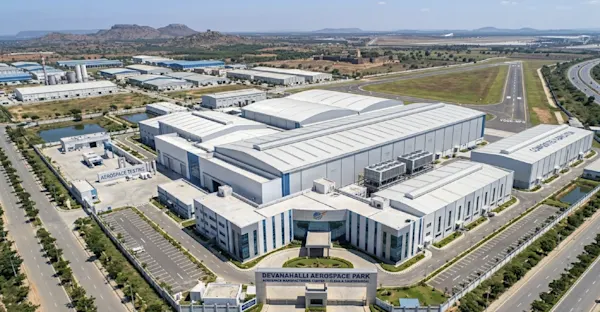
Corridor 3: Devanahalli and Bellary Road (NH-44 North)
Best for: Airport-linked logistics, aerospace and defence manufacturing, cold chain (pharma and fresh produce for export), bonded warehouses
Devanahalli has become one of Bangalore's most strategic industrial corridors, driven by Kempegowda International Airport proximity. Any operation with significant air freight — imported components, pharma cold chain, high-value electronics, fresh produce export — belongs in this corridor.
The KIADB industrial zones here offer plots from 1 acre to 10+ acres for custom-built facilities alongside existing Grade A sheds for immediate occupancy.
Available sizes: 30,000–2,00,000 sq ft ready-built; unlimited for KIADB plot and built-to-suit.
Rent: ₹18–28 per sq ft per month for ready-built Grade A. KIADB plot: ₹3,500–6,500 per sqm land cost.
Proximity: 40 km from city centre, 10 minutes from the airport.
Corridor 4: Bommasandra, Jigani and South Bangalore (NH-44 South)
Best for: Manufacturing, automotive assembly, pharma production, engineering, EV components
Bommasandra and Jigani form Bangalore's heavy industrial belt. This corridor is primarily a manufacturing zone — the large spaces here are industrial sheds and factories rather than distribution centres. Bidadi is also growing as an automotive and EV components corridor along NH-48 South.
Available sizes: 15,000–2,00,000 sq ft industrial sheds. More mid-spec existing stock than new-build Grade A.
Rent: ₹20–28 per sq ft per month depending on spec and age.
Proximity: 28–35 km from city centre. Metro connectivity at Bommasandra (operational August 2025) has significantly improved labour access.
Corridor Comparison at a Glance
Nelamangala / NH-48 | Hoskote / NH-75 | Devanahalli / Airport | Bommasandra / Jigani | |
Best use | 3PL, FMCG, bulk | E-commerce, auto, cold chain | Air freight, pharma, aerospace | Manufacturing, assembly |
Max sqft available | 3,00,000+ | 4,00,000+ | 2,00,000 shed / unlimited BTS | 2,00,000 |
Rent range | ₹15–22/sqft | ₹18–26/sqft | ₹18–28/sqft | ₹20–28/sqft |
Clear height | 10–14 m | 10–12 m | 10–15 m | 8–14 m |
Highway | NH-48 (Mumbai) | NH-75 (Chennai) | NH-44 North | NH-44 South |
Airport distance | 55 km | 45 km | 10 km | 50 km |
Time to occupy | 45–90 days | 45–90 days | 45–90 days / 18–24 months BTS | 30–60 days |
What Large Tenants Negotiate Differently
A tenant taking 5,000 sq ft has almost no negotiating leverage. A tenant taking 50,000–5,00,000 sq ft has significant leverage — but only if you know what to ask for. Most large tenants leave value on the table by negotiating only on headline rent.
Rent-free fit-out period. For a large tenant making significant infrastructure investment (racking, conveyors, dock equipment, power upgrades), 3–6 months rent-free is standard and should be treated as a baseline, not a concession. Enosh Infra has secured 6-month rent-free periods for tenants with strong profiles in higher-supply corridors.
Headline rent reduction. Large tenants (1,00,000+ sq ft) regularly achieve 10–20% below a landlord's asking rent in Nelamangala and Doddaballapura where competitive supply is higher. In Hoskote and Devanahalli where demand is tighter, 5–10% reductions are typical. We structure the negotiation across rent, deposit, and escalation simultaneously — not as a single ask on rent alone.
Escalation cap. Standard lease escalation runs 5–8% per year. For a large tenant on a 7–9 year lease, capping escalation at 5% and fixing it in the lease document saves materially over the full term. This single clause is consistently overlooked by tenants who focus only on year-one rent.
Assignment and subletting rights. For 3PLs and e-commerce operators whose customer volumes can shift significantly, the ability to sub-let part of the space or assign the lease to a successor entity without full landlord consent is critical. Many standard lease templates restrict this entirely. Enosh Infra's legal review catches and renegotiates this clause as standard practice.
Built-to-suit structural commitments. For new-build sheds or KIADB plot developments, large tenants can negotiate specific structural commitments from the developer before construction begins — column spacing, clear height, dock count, ESFR specification, power load. These must be in the agreement before the building is constructed; retrofitting them after is expensive or impossible.
Approval Timelines for Large Warehouse Occupancy
Large-format industrial occupancy involves more approvals than small spaces. Most tenants underestimate these timelines and plan their operational start dates accordingly.
Pre-lease technical diligence: 2–4 weeks. Property shortlisting, structural assessment, floor load verification, power infrastructure check, KIADB title and zone verification. Enosh Infra runs this before you visit a single site.
Lease negotiation and legal review: 3–6 weeks. For a 1,00,000+ sq ft lease on a 7–9 year term, in-house legal review is not optional. Our team reviews the lease agreement, verifies the title chain, checks for encumbrances, and renegotiates non-standard clauses before you sign.
Factory Act registration: 4–8 weeks post-possession. Any industrial facility with workers requires registration under the Factories Act 1948, following the Factory Inspector inspection.
Fire NOC: 6–10 weeks. Karnataka Fire & Emergency Services inspection and NOC. For large facilities this involves a site inspection, sprinkler system verification, and escape route compliance check. Begin this on day one of possession.
BESCOM power connection (new HT): 6–12 weeks. For new HT connections above 100 KVA. Existing connections with capacity enhancement take 4–8 weeks. We verify substation capacity before recommending any property.
PCB Consent to Establish (manufacturing, Orange zone): 6–12 weeks. Required for manufacturing activities. Green zone warehousing and logistics does not require PCB consent, which significantly simplifies the approval sequence for 3PL and e-commerce facilities.
The realistic timeline from brief to operational is 90–150 days for existing-shed occupancy with Green zone activity, and 120–180 days for manufacturing with Orange zone activities.
Foreign Companies: Leasing Large Warehouses in Bangalore
For US, UK, European, Japanese, and Korean companies establishing a Bangalore distribution or manufacturing base, large-format industrial leasing involves additional considerations.
100% FDI under the automatic route for warehousing and logistics operations — no prior government approval needed. Most manufacturing sectors allow 74–100% FDI automatically or with simple approval.
FEMA compliance. Foreign companies must lease through a registered Indian entity. Enosh Infra coordinates with company formation advisors so entity setup and property search run in parallel — saving 4–8 weeks versus treating them as sequential steps.
Karnataka incentives. Rental reimbursement, 5-year electricity duty exemption, and EPF contribution support under the 2024 Karnataka Industrial Policy are available to eligible foreign-invested manufacturing companies. These must be registered before occupancy commences — not retroactively.
For companies needing a complete India setup — registered entity, office space, and large warehouse together — Enosh Infra's GCC and business launch service covers the full scope.
Conclusion: The Right Large Warehouse Is a Competitive Advantage
In Bangalore's 2026 industrial market, the right large warehouse is not just a cost line — it is an operational advantage. The difference between a 3PL in the right Nelamangala cluster versus a mismatched corridor, or a 1,00,000 sq ft facility with the right dock count versus one that limits throughput from day one, compounds across a 7-year lease term.
Enosh Infra specialises in exactly this: large-format industrial space for tenants who need more than a listing — they need a technical pre-inspection, a negotiation specialist, and a legal review before they sign a lease they will live with for the next 5–9 years.
Whether you are a 3PL consolidating your Bangalore footprint, an e-commerce company building a regional fulfilment centre, a foreign manufacturer establishing your India distribution base, or an industrial company needing a large KIADB-zone shed — contact Enosh Infra for a focused shortlist matched to your specification and timeline.
Phone / WhatsApp: +91-8073582033 Email: info@enoshinfra.com