For Korean and Japanese teams: 한국어 안내 · 日本語のご案内
A foreign company can be running a leased warehouse or light-manufacturing shed near Bangalore in about 8 to 12 weeks, as long as the entity, the site search and the document checks happen at the same time. Doing them one after another is the usual reason it takes months longer.
This guide is for the people at headquarters who have been asked to make India happen: a Korean parts maker following a customer, a Japanese supplier adding capacity, a Taiwanese electronics firm, a German engineering company, or a US logistics operator. It covers the order of work, the choices that matter early, and the points where a lawyer or accountant has to sign off. If you are still weighing whether Bengaluru is the right city, our earlier piece on why Bengaluru draws global industrial investment makes that case. This one starts after the decision.
Who signs the lease: decide the entity first
In most cases a wholly-owned Indian subsidiary signs the lease, so the entity comes before anything else.
The subsidiary is the tenant, and the leased premises become its principal place of business. GST registration is tied to that address: the registered lease deed, a utility bill and the landlord's NOC are the proof of address you need to obtain it. The operating licences are tied to the same site: the factory licence under the Factories Act, 1948, the trade licence, KSPCB consent to establish and to operate, the Fire NOC, and FSSAI if you handle food or agricultural products. So the company and the building have to be planned together.
Manufacturing and warehousing or logistics can be 100% foreign-owned under the automatic route, with no prior approval from the RBI or the Government of India. The exception is a company from a country that shares a land border with India, which needs government approval under Press Note 3. Incorporation through the MCA's SPICe+ form usually takes 10 to 20 working days, about three to four weeks, provided the apostilled or consularised documents from abroad (MoA and AoA, board resolutions, directors' identity proofs) are ready.
Two other routes come up early. A branch office can lease property for up to five years without prior RBI permission, which works for a short commitment but not for a factory you plan to run for a decade. A liaison office cannot carry on business, so it cannot run a site.
If you would rather own the land: the foreign parent cannot buy land in India, but an Indian subsidiary can buy private industrial land or take a KIADB plot on a long-term lease.
Three ways to get a building
You can lease a building that already stands, have a landlord build one to your specification, or take land and build it yourself.
Lease a ready shed or warehouse. The fastest route, when an existing building fits your size, height, floor load and power. We handle requirements from 10,000 to 400,000+ sq ft (about 929 to 37,000+ ㎡). Rents differ a lot from one corridor to the next; the rental rate index has current figures.
Build to suit. When nothing standing fits, often because of crane height, clean areas or heavy floor loads, a landlord builds to your specification on their land and leases it to you. These leases typically run 9 to 12 years, longer for specialised buildings, and a standard pre-engineered building takes about 4 to 8 months to build, plus approvals. See how build to suit works.
Take land and build. Your subsidiary leases or buys a KIADB plot or converted private land and builds. You get full control, and you also carry the construction programme and its approvals.
It helps to decide early which parts of your specification are fixed and which can bend. A team that can live with a slightly lower eave height may find a dozen ready buildings where it had none. Our comparison of ready sheds, build to suit and KIADB plots goes through the trade-offs.
Where around Bangalore
Industrial Bangalore is a ring of corridors around the city, and each direction suits different work. Every corridor below links to a page with its sizes, zones and rents.
North, towards the airport: Devanahalli and Doddaballapura, for manufacturing that needs air freight or large parcels.
North-west, on the Tumkur Road: Nelamangala and Dabaspet, with Tumakuru further out for large land requirements.
East: Hoskote, a large logistics and warehousing cluster, with Narasapura further along the same highway.
South: Bommasandra, Jigani, Anekal and Electronic City, the established engineering and electronics belt.
South-west: Bidadi and Harohalli, with land for larger and build-to-suit facilities.
For Tumakuru and Narasapura, where the requirement is usually land or build to suit, start from the industrial land and build to suit page.
Choose the corridor for your customers, suppliers and workforce first, and for rent second. A cheaper building an extra hour from your main customer rarely stays cheaper by the end of the year.
Approvals shape the shortlist
The approvals your process needs decide which sites are possible at all, so check them before you get attached to a building.
KIADB zone. Karnataka's industrial areas are classed Red, Orange and Green, broadly heavy, medium and light industry. A site in the wrong class for your process is a dead end however good the building is. The industrial zones guide explains the classes.
Pollution consent. The Karnataka State Pollution Control Board category follows your process, not the building. You need Consent for Establishment before you set up, and Consent to Operate before production starts.
Fire. Two layers: the building's own fire clearance, which is the landlord's, and the operating Fire NOC, which you apply for based on what you store and how hazardous it is.
Factory licence. A manufacturing operation needs factory plan approval and a licence before it runs.
KIADB land. If the building stands on KIADB land under lease-cum-sale, the landlord usually needs KIADB's written permission to sub-let to you. Ask for it early; its absence is one of the most common reasons an industrial deal stalls late.
The document checklist for every lease is in our industrial leasing guide.
How long it takes
Plan on about 8 to 12 weeks from a clear requirement to go-live for a warehouse or light-manufacturing operation, with the work running in parallel.
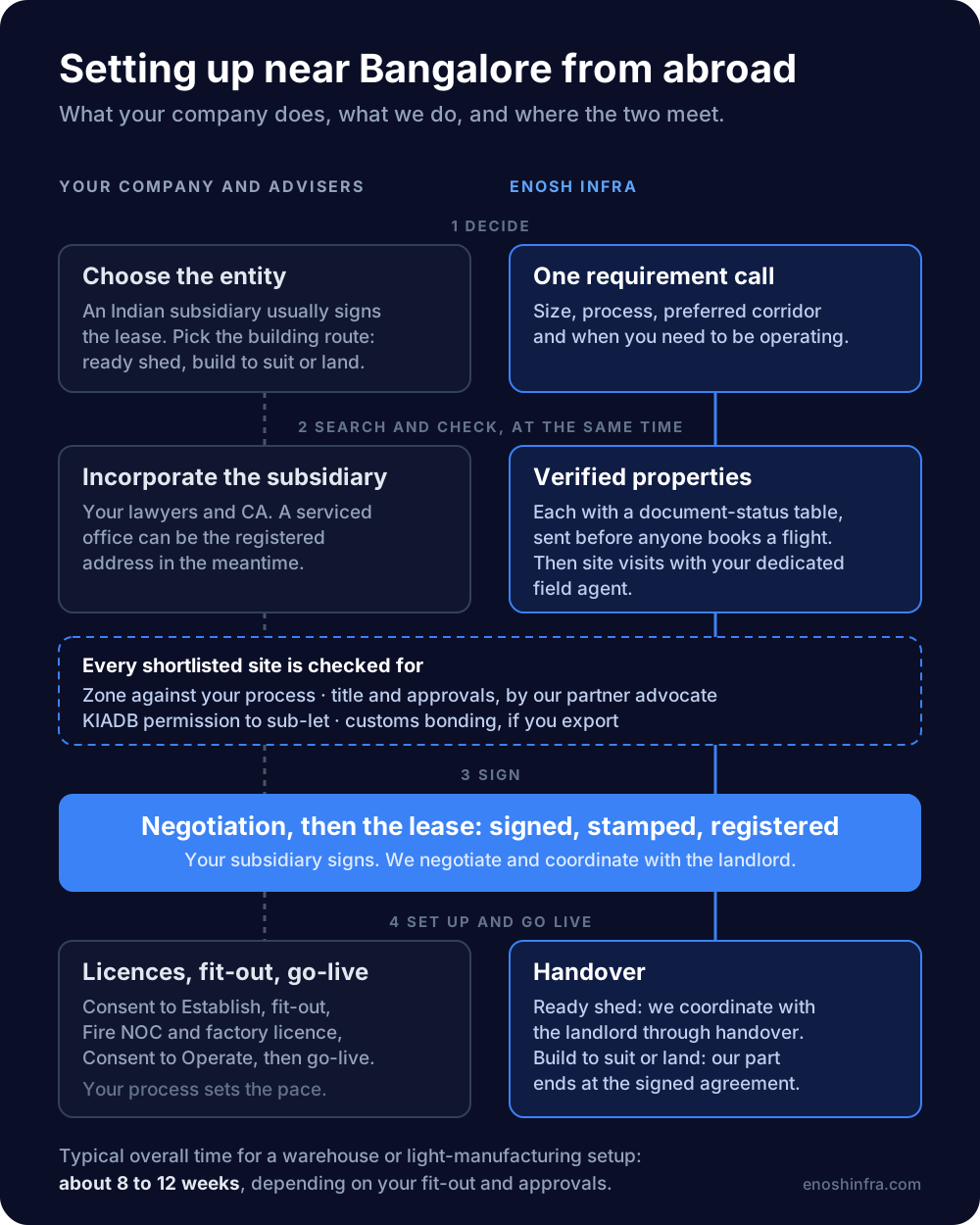
Setting up near Bangalore from abroad: what your company does and what Enosh Infra does
In practice the subsidiary is being incorporated while sites are shortlisted and their documents checked, and a serviced office can be the registered address in the meantime. Licences and fit-out overlap once the lease is signed. A lease of 12 months or more has to be stamped and registered.
Three things stretch the timeline: a Red-category process that needs an environmental assessment (allow 6 to 12 months), a build-to-suit facility (the build time above, plus approvals), and land whose title needs work. None of them rules a site out, but each belongs in the plan from day one.
Exporting? Check customs bonding before you choose the building
If you will import components or machinery and export what you make, look at customs bonding before you sign, because the building itself is what gets licensed.
Two parts of the Customs Act matter. Section 58 covers bonded warehouses for duty-free storage. Section 65, the MOOWR scheme, lets a licensed manufacturer defer import duty on capital goods and inputs used in manufacturing. For an export-oriented plant the effect on cash flow can be large, and the premises has to qualify, so the question belongs in the site brief rather than after the move.
Running the search from abroad
A team at headquarters usually cannot spend weeks in Bangalore, so the work is set up to need as few trips as possible.
You send one requirement. We come back with verified properties, each with a document-status table showing what has been checked and what is still pending, before anyone books a flight. A dedicated field agent stays with you through the visits, the negotiation and the handover. If your headquarters reads Korean or Japanese, our Korean and Japanese pages describe the same process.
When you submit a requirement, we email our service charges, terms and workflow before any site visit.
Where our work starts and stops
We find the site, have its documents checked by our partner advocate, negotiate the lease, and coordinate between you and the landlord until the lease is signed and the building is handed over.
We do not incorporate your company, file your licences, or design and build your facility. Those stay with your lawyers, accountants and consultants, and with the landlord for the building's own compliance. For build to suit and land, our work ends when the agreement is signed.
Enosh Infra has been an industrial and commercial property consultancy in Bangalore since 2019. We work with companies entering India as well as businesses already here.
Planning a site near Bangalore? Tell us the size, the process and when you need to be operating, and we will come back with how we would approach it. Tell us your requirement
Prefer to read first? Download the Karnataka Market Entry Guide (free).