For Korean and Japanese teams: 한국어 안내 · 日本語のご案内
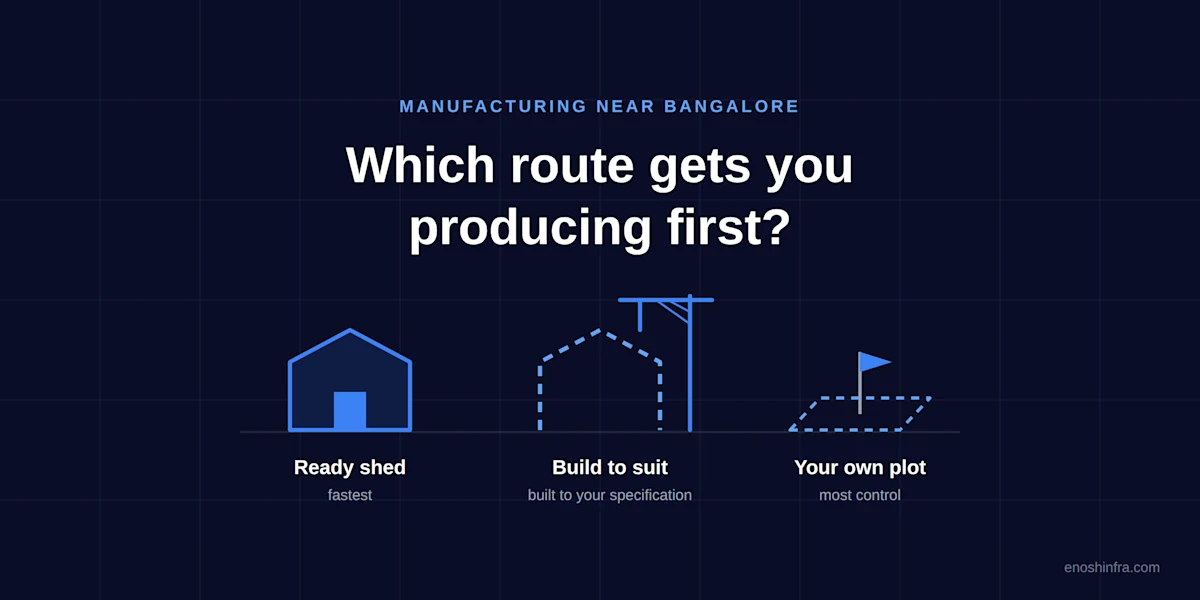
If a ready building fits your specification, leasing it is the fastest way to start producing near Bangalore. Build to suit comes next, at about 4 to 8 months of construction for a standard pre-engineered building plus approvals. Taking your own plot and building gives you the most control and the longest road.
The harder question is which of your requirements are fixed. That is what decides the route, so this post starts there.
Start from the specification, not the route
Write down the few things the building cannot do without, and treat everything else as negotiable.
For most manufacturers the fixed items are some of these:
Clear height at the eaves. Racking and crane hook height depend on the side (eave) height, not the centre height that listings often quote.
Crane. A crane needs beams designed into the structure. It can rarely be added to a building that was not built for one.
Floor load. General industrial floors are commonly around 5 T/sqm; racking usually needs 8 to 10 T/sqm.
Power. The sanctioned load on the landlord's power letter, not what the building looks able to take.
Clean or controlled areas, a special production line, or a process in a heavier pollution category.
Mezzanines. Any mezzanine has to appear in the sanctioned building plan.
If your list survives contact with the ready stock, lease. If one or two items rule out everything standing, that is the case for build to suit. If the process itself is unusual, or you want to own the asset, look at land.
Route 1: lease a ready shed
A ready building is the quickest route, and the one with the least capital at risk.
Most modern sheds near Bangalore are pre-engineered buildings, with eave heights of about 9 to 13.5 m and column-free bays of up to 30 m or more. Older estates such as Peenya and the core of Bommasandra have more concrete (RCC) units, usually 4 to 7 m per floor with columns every 6 to 8 m, which suit heavy machinery on the ground floor and smaller footprints. Our industrial sheds page compares the two.
For a warehouse or light-manufacturing operation, the full path from requirement to go-live is about 8 to 12 weeks, with the shortlist, document checks, lease and licences overlapping. You commit to the lease term and the fit-out; the building is the landlord's problem.
The catch is fit. You take the building as it is, plus what the landlord agrees to change, and the best-located buildings in the right zone are not always free when you need them.
Route 2: build to suit
Build to suit means a landlord builds to your specification on their land and leases it to you.
It makes sense when nothing standing fits your size or layout, which is common from about 50,000 sq ft upward, or when you need higher eaves, heavier floors, clean rooms or a specialised line. Construction is usually funded by the landlord against a rent you commit to in advance, so you spend less of your own capital than you would building yourself.
In return you commit for longer. Build-to-suit leases typically run 9 to 12 years, longer for specialised facilities. A standard pre-engineered building takes about 4 to 8 months to build; allow more for approvals and for large or complex builds.
The document that matters is the Agreement to Lease, signed before construction starts. It fixes the specification, the rent, escalation, lock-in and the construction timeline, and the lease deed follows at handover. Get the specification into that agreement in detail, because whatever is left vague at this stage is what you argue about at handover. More on the route: industrial land and build to suit.
Route 3: take a plot and build
Leasing or buying land and building yourself gives you the most control, and you carry everything that comes with it.
Your Indian subsidiary takes the plot, then owns the design, the contractor, the programme and the approvals. A foreign parent cannot buy land in India; an Indian subsidiary can buy private industrial land or take a KIADB plot on a long-term lease.
There are two kinds of land to choose between.
A KIADB plot. KIADB allots industrial land under a lease-cum-sale agreement. Until the absolute sale deed is executed, KIADB is still the lessor, and the land may only be used for industry.
Converted private land. Agricultural land needs a DC conversion order for industrial use. A building on unconverted land is illegal, however long it has stood.
We do not put a timeline on this route, because it depends on the plot, your design and your approvals more than on anything we control. It is the longest of the three.
A note on plug and play
"Plug and play" usually means a ready building in a managed industrial park, with power and services connected and shared facilities on site. In Bangalore that is the ready-shed route above, often in a Grade A park. India's government approved a national plug-and-play industrial park programme in March 2026; check what is actually built and open near Bangalore before you plan around it.
How the three compare
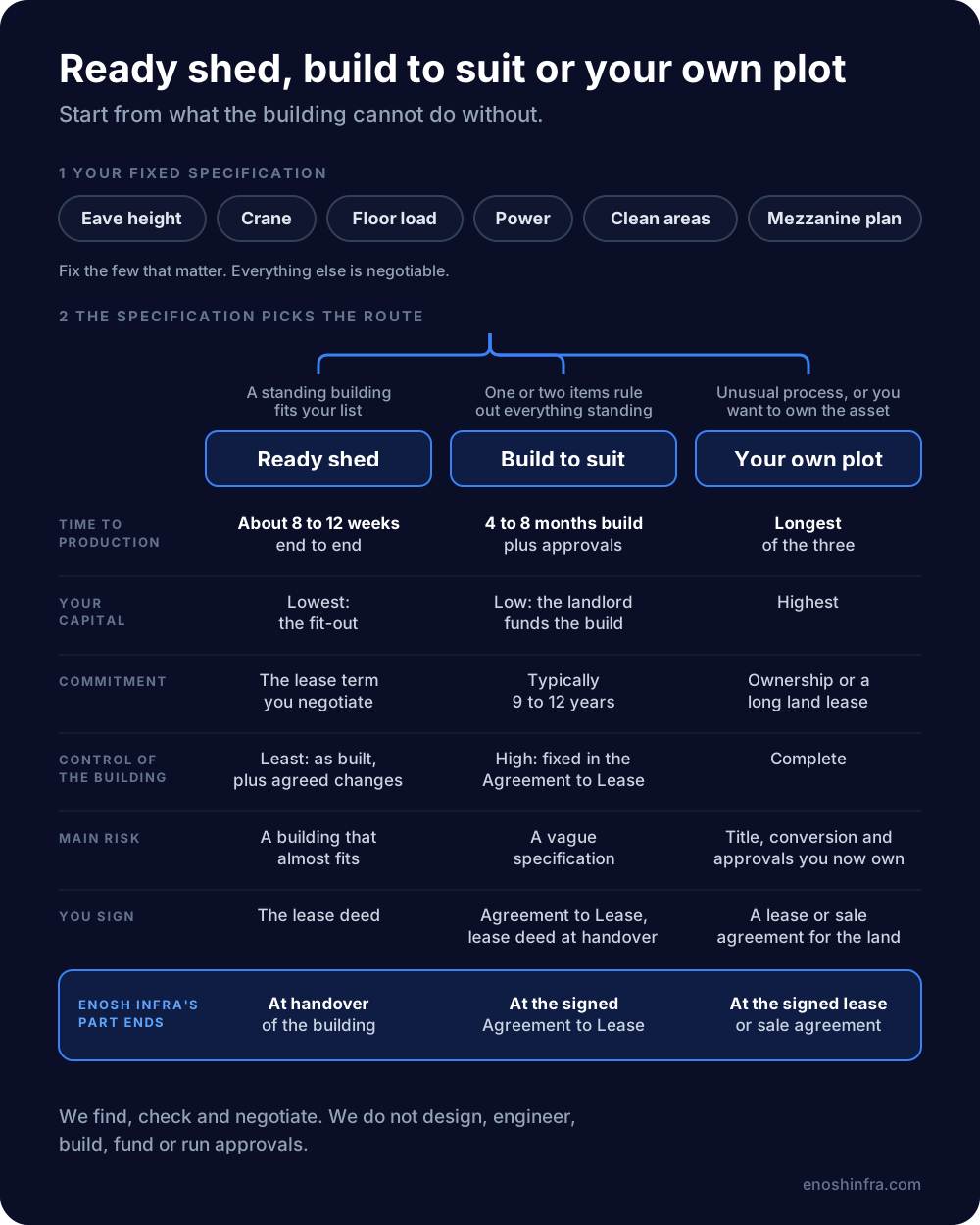
Ready shed, build to suit or your own plot: how the three routes compare
Time to production: ready shed fastest (about 8 to 12 weeks end to end for a warehouse or light manufacturing); build to suit next (4 to 8 months of construction plus approvals); own plot longest.
Your capital: ready shed lowest (fit-out); build to suit low (landlord funds construction against committed rent); own plot highest.
Commitment: ready shed is the lease term you negotiate; build to suit typically 9 to 12 years; own plot is ownership or a long land lease.
Control of the building: ready shed least; build to suit high, set in the Agreement to Lease; own plot complete.
Main risk: ready shed, a building that almost fits; build to suit, a vague specification; own plot, title, conversion and the approvals you now own.
Questions to settle before you choose
Which three items on your specification would you walk away over?
How many years can the business commit to one building?
Will you import and export? Customs bonding and MOOWR depend on the premises being licensed, so the answer can change which building qualifies. Our guide for foreign companies covers this.
Does your process fall in a Red, Orange or Green category? That rules corridors in or out before the route matters. See the industrial zones guide.
Where our work starts and stops
For a ready shed, we find the buildings, have the documents checked, negotiate the lease and coordinate through handover. For build to suit and land, our work ends when the Agreement to Lease, or the lease or sale agreement, is signed. We do not design, engineer, build, fund or run approvals.
Enosh Infra has been an industrial property consultancy in Bangalore since 2019, handling requirements from 10,000 to 400,000+ sq ft.
Not sure which route fits? Send us your specification and timeline, and we will tell you which routes are realistic and where. Tell us your requirement