For Korean teams: 한국어 안내: 외국 기업 · 공장 부지와 BTS(맞춤형 건설)
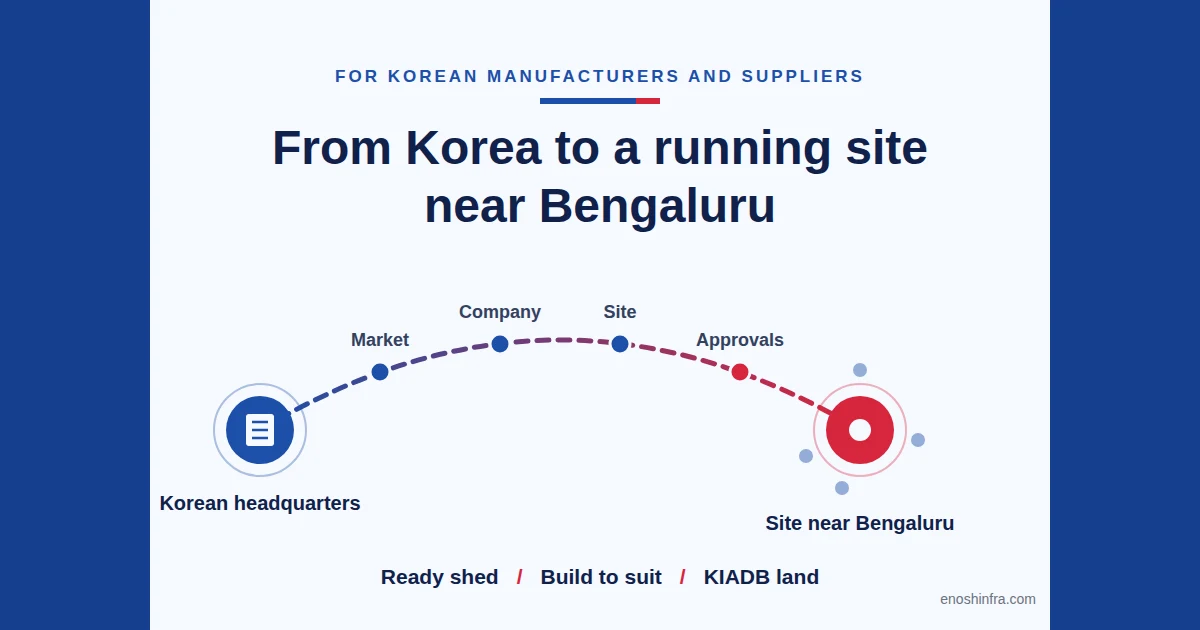
A Korean manufacturer or supplier looking at Karnataka usually has three decisions to make, in this order: which customer it has to be close to, whether a ready shed will do or it needs build to suit or a KIADB plot, and which public bodies to lean on for market data, introductions and approvals. Get the first one right and the other two get much easier.
This guide is for the people planning it: the overseas business team at headquarters (해외사업팀), the India country manager, or the Tier-1 or Tier-2 supplier that has just been asked to follow a customer. The general steps for any foreign company, from the Indian subsidiary to the licences, are in our guide to setting up a factory or warehouse in Bangalore. This post covers what is different when the company is Korean.
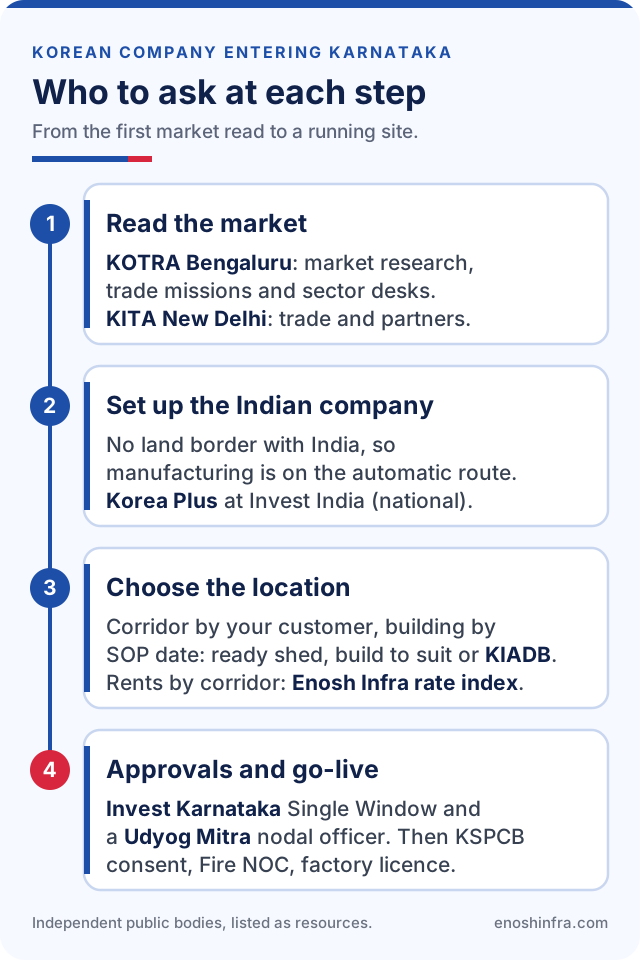
Korean company entering Karnataka: who to ask at each step
Why Karnataka is on Korean shortlists
Because a large Korean manufacturer has just opened here, and the state is courting more.
In August 2026 DN Solutions opened its first Indian plant in the ITIR industrial area north of Bengaluru, on 25 acres developed with KIADB, with machining and turning centres, R&D and after-sales support on one site. The company pointed to Karnataka's depth in precision manufacturing, automation and engineering talent (Outlook Business). In 2024 Karnataka signed agreements in Seoul with DN Solutions and with EMNI, a battery firm working on storage, testing and recycling of LG Energy Solution cells (NBM&CW). The same trip produced an agreement with HyVision System, a Korean maker of camera-module inspection equipment, for a plant at Devanahalli near the Foxconn unit (Inc42). And Kia's plant at Penukonda in Andhra Pradesh lies just off NH-44, under 150 km from Bengaluru (ThePrint). These are public reports, listed to show what is around; none of these companies is named as an Enosh Infra client.
To be clear about the limits: most Korean auto suppliers in India have settled near their customers' plants, and several of those are outside Karnataka. Bengaluru makes sense when your customer, your engineers or your market are here, not as a default.
Start from your customer, then pick the corridor
Your customer's location decides the corridor; rent comes second.
The corridors around the city each face a different way:
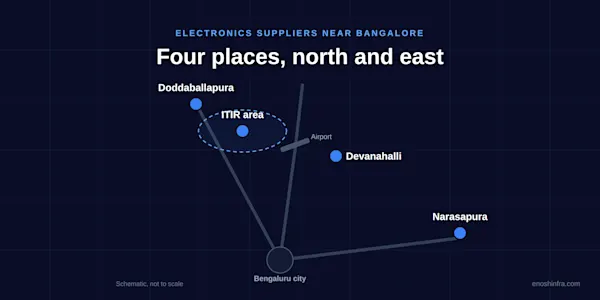
North, the airport side: Devanahalli and Doddaballapura. Closest to the ITIR area, and the side of the city that faces the highway north towards Andhra Pradesh. Our guide for suppliers north and east of Bangalore goes area by area.
South: Bommasandra and Jigani, the established engineering and precision belt, with more small and mid-sized ready sheds.
South-west: Bidadi and Harohalli, with land for larger and build-to-suit plants.
East: Hoskote, and further out Narasapura, a KIADB area known for automotive and engineering units (current range in the rental rate index).
A Tier-1 supplier delivering sequenced parts to a line wants short, predictable trips, so it sits as close to that line as it can. A Tier-2 supplier feeding several Tier-1s can sit where the buildings and the workforce are, and often ends up in the older southern estates.
Location also sets your rent, and the gap between corridors is wide. Our Bangalore industrial rental rate index gives current ranges by corridor, our industrial market reports cover supply and demand in more depth, and the industrial zones guide lists the KIADB areas and their pollution categories, which decide what you can make there.
Your start-of-production date picks the building
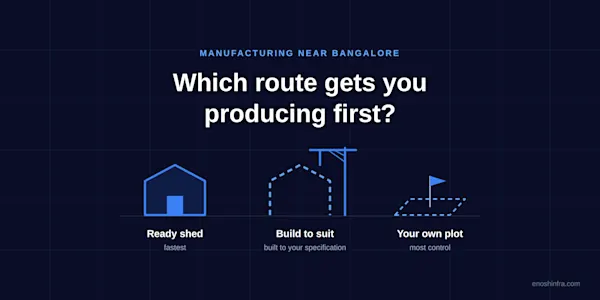
Work back from your SOP (start of production) date: it usually decides between a ready shed, build to suit and a plot.
Ready shed. The quickest route when a building fits. Tier-2 suppliers with modest presses, machining or assembly often find one. We handle requirements from 10,000 to 400,000+ sq ft (about 929 to 37,000+ ㎡).
Build to suit. When you need crane beams, heavy floors for presses, higher eaves or a clean area, a landlord builds to your specification and leases it to you. A standard pre-engineered building takes about 4 to 8 months plus approvals, and the lease typically runs 9 to 12 years. Heavier Tier-1 requirements usually point this way.
KIADB plot or private land. Your Indian subsidiary leases a KIADB plot or buys converted private land and builds. The most control, the longest road, and the one route where the SOP date depends most on things outside your hands.
If the SOP date is fixed by your customer and close, a ready shed or build to suit is usually the realistic choice, even if land is the long-term plan. The full trade-offs are in our comparison of ready sheds, build to suit and KIADB plots.
Public bodies a Korean company can use
Several public bodies help Korean companies entering India, each with a different job. These are independent public organisations, listed here as resources.
KOTRA's Bengaluru office (KOTRA 벵갈루루무역관), at Embassy One on Bellary Road. KOTRA is the Korea Trade-Investment Promotion Agency. Its Bengaluru page lists market research, trade missions and inquiries, sector desks including machinery and construction, and consultation on investment into India. KOTRA Bengaluru
KITA New Delhi Center (한국무역협회 뉴델리지부), the India office of the Korea International Trade Association, in Gurugram. It supports trade and investment delegations, researches Indian regulations and use of the India-Korea CEPA, helps find Indian partners and gives advice on import and export procedures. KITA New Delhi
Korea Plus at Invest India. A national desk for Korean investors inside Invest India, India's investment promotion agency, launched in New Delhi in 2016. It works with embassies, central and state governments and industry bodies. It is not a Karnataka office. Korea Plus
Invest Karnataka and Karnataka Udyog Mitra. The state's own channel. Its Single Window System covers over 150 state services from more than 30 departments, and Karnataka Udyog Mitra assigns a nodal officer to each investment proposal. Invest Karnataka
KIADB (Karnataka Industrial Areas Development Board), which develops the state's industrial areas and allots plots. KIADB
What none of them does is lease you a privately owned building or negotiate one for you. Ready sheds and build to suit are a commercial search, run alongside the help above.
Questions Korean headquarters teams ask
Do we need government approval to invest? For manufacturing or warehousing, usually not. The prior-approval rule in Press Note 3 applies to countries that share a land border with India, and Korea does not, so these sectors are on the 100% automatic route.
Will imports from Korea cost less? Possibly. The India-Korea Comprehensive Economic Partnership Agreement has been in force since 1 January 2010, and many tariff lines carry reduced duty. Your customs adviser confirms the rate for each item. If you will also export, look at customs bonding before you choose the building; our foreign-company guide explains why.
Can our parent company own the land? Not directly. The Korean parent cannot buy land in India; its Indian subsidiary can buy private industrial land or take a KIADB plot on a long-term lease.
How do we run the search from Seoul? Bengaluru is three and a half hours behind Seoul, so the Seoul afternoon is the Bengaluru working morning, which is when calls work best. Shortlists and document checks can be done before anyone flies, and our Korean-language page describes the process for colleagues who prefer to read it in Korean.
Where our work starts and stops
Our part is the property: the search, the document checks through our partner advocate, the negotiation, and the coordination with the landlord up to handover of a ready building. On build to suit or land, we stop at the signed agreement. Your company's incorporation, licences, design and construction sit with your own advisers and contractors, and with the landlord.
Enosh Infra has been an industrial and commercial property consultancy in Bangalore since 2019, working with companies entering India as well as businesses already here.
Following a customer to Karnataka? Tell us who you supply, the size and process, and your SOP date, and we will come back with the corridors and buildings that fit. Tell us your requirement